
Bee Hives for Outdoor and Greenhouse Crops
Commercial Crop Pollination Solutions for New Zealand Growers

Commercial Pollination Solutions for New Zealand Growers
Many horticultural crops grown in New Zealand rely on effective insect pollination for successful fruit set and consistent production. Over time, widespread use of broad-spectrum insecticides has significantly reduced pollinator populations, impacting yield and fruit quality across the industry.
Growers are seeing smaller fruit and lower counts per plant — in most cases directly attributable to insufficient pollination.
Zonda bumblebee hives provide a reliable, managed pollination solution for greenhouse and outdoor crops, helping New Zealand growers achieve better fruit quality, higher yields and stronger returns.
Bumblebees are exceptionally effective pollinators both in glasshouses, under cover crops and in open-air situations.

Bumblebees Give the Grower a Major Advantage
Commercial growers across New Zealand are choosing Zonda bumblebee hives because of the clear advantages they deliver over other pollination methods:
- Each bumblebee transfers more pollen to the stigma compared to other pollinators, creating better fruit formation and a higher percentage of Class 1 fruit at harvest.
- A bumblebee visits more flowers per hour than other pollinators.
- Bumblebees work in lower temperatures and low light conditions — they can fly at temperatures as low as 8°C, in light rain, windy conditions and heavy cloud cover.
- Bumblebees work reliably in covered crops, under netting and in plastic tunnels — situations in which other pollinators sometimes fail.
- As in the wild, bumblebees work very well alongside honeybees.
- Bumblebees are a more viable option than honeybees, which have become more expensive and harder to source following the spread of Varroa.
- Using bumblebee hives means significant labour savings compared with artificial pollination techniques. As the number of misshapen fruits declines, this also saves time and labour in sorting the harvested product.
- Bumblebees will only travel in a 100–200 metre radius, so they will remain within the crop requiring pollination.
- Bumblebees are rarely aggressive, meaning greater safety for you and your employees.
Buzz Pollination — Why Bumblebees Outperform Other Pollinators
Bumblebees pollinate flowers through a method called ‘buzz pollination’ (also known as sonication). The bumblebee grabs onto the flower and anthers to vibrate and dislodge the pollen. This allows a bumblebee to pollinate a flower in a single visit, whereas a honeybee may need to visit the same flower 7–10 times before it is fully pollinated.
This is particularly important for crops such as tomatoes, capsicum, eggplant, blueberries and kiwifruit, where buzz pollination produces significantly better fruit set and fruit quality than pollination by honeybees or artificial vibration methods.

Bumblebee Hives for Greenhouse Crops
Many horticultural crops grown in greenhouse environments rely on insect pollination to achieve successful fruit set and consistent crop production. In protected cropping systems such as glasshouses, tunnel houses and other covered growing environments, natural pollinators are often limited — making managed bumblebee colonies the most reliable way to ensure consistent pollination throughout the flowering period.
Zonda bumblebee hives are designed for greenhouse use and provide a stable, self-contained environment for the colony while allowing bees to forage throughout the crop. The hive requires no maintenance once placed in the greenhouse and can be directed using the built-in slider door.
Greenhouse Crops That Benefit from Bumblebee Pollination
Zonda bumblebee hives are commonly used in New Zealand greenhouses for pollination of:


For full crop information, hive sizing and placement guidance, visit our Greenhouse Crop Pollination page.
Bumblebee Hives for Outdoor Crops
For outdoor cropping systems, bumblebees reliably supplement natural pollinator activity — particularly where pollinator decline, environmental conditions, crop structure or crop protection products may affect pollination success. Introducing managed hives helps ensure reliable pollen transfer during flowering and supports stable crop production.
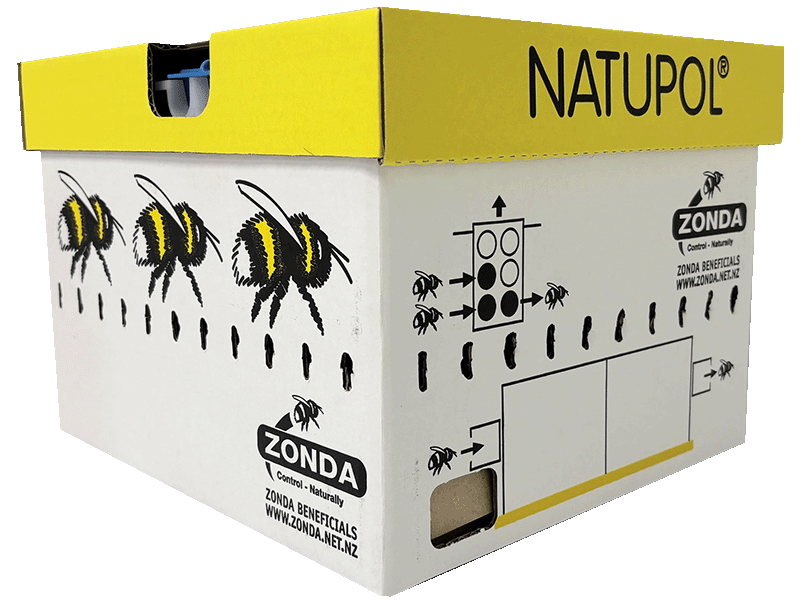
Zonda outdoor hives are supplied in a sealed cardboard box designed for outdoor use, with airflow and ventilation to maintain suitable conditions for the colony.
Outdoor Crops That Benefit from Bumblebee Pollination
Zonda bumblebee hives are used across a wide range of outdoor horticultural crops in New Zealand:





For full crop information, hive sizing and placement guidance, visit our Outdoor Crop Pollination page.
Hive Options for Commercial Growers
Zonda hives are available in three sizes to match different cropping areas. All hives are fully self-contained, requiring no maintenance once placed. Each hive is supplied with a queen, worker bees, a pollen source and a sugar syrup food source sufficient for the life of the hive. Under normal conditions, colonies typically remain productive for approximately four to six weeks.
Small Hive
up to 750 m²
Contains approximately 50 worker bees.

Large Hive
1100 m² to 1500 m²
Contains approximately 80–100 worker bees.
Frequently Asked Questions
How many bumblebee hives do I need per hectare?
This depends on the crop, canopy density, and flowering period. Avocado for example, require 6-7 large bumblebee hives per hectare. For specific recommendations based on your crop type and growing system, contact the Zonda team.
Can bumblebee hives be used under netting or in tunnels?
Yes. Zonda bumblebee hives perform reliably in covered crops, plastic tunnels, and under insect netting — conditions where honeybees or natural pollinators are often unavailable or ineffective.
How long do commercial bumblebee hives last?
Under normal crop conditions, colonies typically remain productive for approximately four to six weeks, depending on conditions and colony performance. Zonda hives are guaranteed for a minimum of four working weeks.
Can I use bumblebee hives alongside honeybees?
Yes. Bumblebees and honeybees work very well together. Using both can improve overall pollination coverage, particularly in larger growing areas or crops that benefit from both buzz pollination and standard pollination activity.
Do bumblebee hives work in low temperatures?
Yes. Bumblebees can fly at temperatures as low as 8°C and will continue foraging in light rain, wind and low light conditions. This makes them particularly valuable for early-season crops and cooler growing environments across New Zealand.
Are bumblebees safe for staff working in the crop?
Bumblebees are virtually never aggressive and present minimal risk to workers. They will generally only sting if directly handled or trapped. Zonda bumblebee hives are routinely used in commercial growing environments with no significant safety concerns.
Can I buy bumblebee hives for crops online in New Zealand?
Yes. Zonda bumblebee hives are available to order online with overnight courier delivery throughout New Zealand. Order from our online shop, or contact us for commercial pricing on larger volumes.