
Avocado
Pollination Solutions
Persea Americana

Effective avocado pollination is essential for achieving reliable fruit set and consistent crop yields. Avocado trees have a unique flowering behaviour that requires effective pollen transfer between flowers, making insect activity during flowering critical for successful fertilisation.
Zonda bumblebee hives support New Zealand avocado growers with reliable, orchard-scale pollination throughout the flowering period.
Avocado Flower Biology
- The avocado flower is small (up to 1 cm) and hermaphroditic, containing both male and female structures. Flowers are borne on terminal panicles — a single panicle may produce around 1,000 flowers per day, with a mature tree producing up to one million flowers per season.
- Each flower opens twice over two consecutive days in a process known as dichogamy. On the first opening, the flower is functionally female with a receptive stigma but no pollen release. On the second opening, it becomes functionally male, releasing pollen while the stigma is no longer receptive.
- Avocado cultivars are classified into Type A and Type B flowering groups. Type A varieties (such as ‘Hass’) open as female in the morning and male the following afternoon. Type B varieties (such as ‘Ettinger’ and ‘Fuerte’) open as female in the afternoon and male the following morning.
- Due to this flowering pattern, cross-pollination between compatible Type A and Type B varieties is required for effective fertilisation and maximum fruit set. Orchards are commonly interplanted with complementary varieties to support pollen transfer.
- Inadequate pollination is a major limiting factor in avocado production. Honeybees are often less effective, as they may prefer alternative flowering sources and may not move efficiently between avocado varieties.
Managed Bumblebee Pollination for Avocado Orchards
Bumblebee pollination supports effective pollen transfer in avocado crops, where the unique flowering behaviour requires movement of pollen between flowers and often between different varieties.
Due to the separation of male and female flower phases, successful pollination depends on reliable insect activity throughout the flowering period. Bumblebees are well suited to this task, as they:
- Visit large numbers of flowers during foraging
- Move efficiently between trees and across orchard blocks
- Transfer pollen between different flowering types (Type A and Type B)
- Remain active under a wide range of environmental conditions
Unlike honeybees, which may be attracted to competing flowering crops, bumblebees are less likely to leave the orchard and tend to forage more consistently within the crop. This behaviour supports improved pollen transfer, particularly in interplanted orchards.
Reliable bumblebee activity helps improve fruit set and supports more consistent yields in avocado production systems.
When to introduce Bumblebee Hives for Avocado Pollination
For pollination of avocado crops, a minimum of 6-7 LARGE colonies per hectare is recommended. In addition to honeybees at a minimum of 3-4 hives per hectare.

On delivery, a LARGE colony contains 80–110 worker bees and a queen, with a typical lifespan of four to six weeks depending on crop conditions.

For ‘Ettinger’ and ‘Hass’ interplanting, introduce hives in three stages: at the start of ‘Ettinger’ bloom (~5% flowering), at peak ‘Ettinger’ bloom as ‘Hass’ begins, and at peak ‘Hass’ bloom. Honeybee hives should be introduced at each stage alongside bumblebee placement.
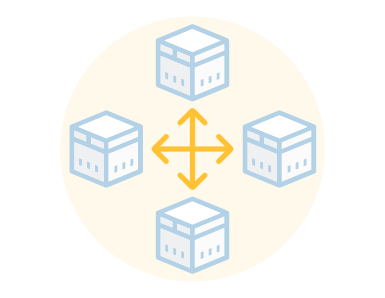
Colony density may be adjusted depending on orchard layout, tree age, bloom intensity and the presence of additional pollinating insects.
Bumblebee Hives for Avocado Orchards
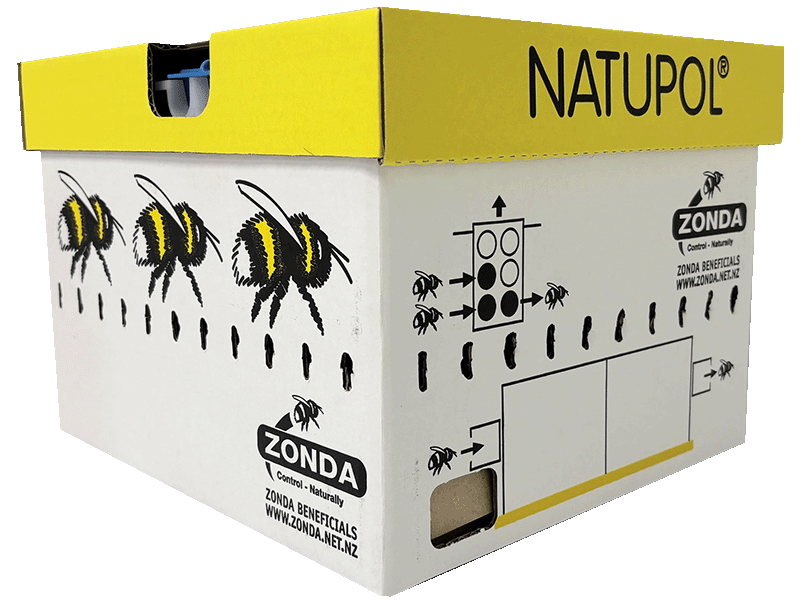
Explore Zonda Beneficials bumblebee hives for outdoor crop pollination to support avocado crop production.
Large Hive
1100 m² to 1500 m²
Contains approximately 80–100 worker bees.
Bumblebee Hive Placement and Use
- Introduce colonies when the first flowers are open.
- Place hives on a sturdy support approximately 50 cm above the ground — sunny in spring, shaded later in the season.
- Secure hives to prevent ant access.
- After placement, allow bees to settle for 30–60 minutes before opening the flight hole. They will begin pollinating shortly after their initial orientation flights.
- Bumblebees are most active between 15–25°C, and will work in temperatures from 10–30°C.
Bumblebee Safety and Crop Protection
- Bumblebees are compatible with natural enemies and biological control programmes.
- Agricultural chemicals can affect bumblebees directly (killing workers or larvae through contact or ingestion) or indirectly (treated flowers may deter foraging visits).
- Systemic pesticides can have long-lasting effects. In crops that produce both nectar and pollen (e.g. sweet pepper), the impact on the colony can be significantly greater than in pollen-only crops (e.g. tomato).
- Detailed information on pesticide compatibility is available in Zonda’s Side Effects Guide.
- Before any crop treatment, activate the BEEHOME option to allow bees to enter but not leave the hive. After approximately one hour, the hive can be fully closed and either covered or removed from the crop.
- If temporarily removed, store the hive at 18–20°C.