
Blueberry
Pollination Solutions
Vaccinium Corymbosum

Effective blueberry pollination is essential for achieving reliable fruit set and high-quality berry development. While some blueberry varieties are capable of self-pollination, insect activity during flowering plays a critical role in improving pollination efficiency and yield.
Zonda bumblebee hives support New Zealand blueberry growers with reliable, orchard-scale pollination throughout the flowering period.
Blueberry Flower Biology
- The blueberry flower (Vaccinium spp., including Vaccinium corymbosum, V. ashei, V. angustifolium and V. myrtilloides) is bell-shaped, hermaphroditic and capable of self-pollination.
- The flower produces nectar, which attracts pollinating insects during the flowering period.
- The pistil typically protrudes just beyond the corolla, allowing both self-pollination and cross-pollination to occur. In many cases, cross-pollination between different varieties results in improved fruit set and higher yields.
- Bumblebees collect pollen by hanging upside down on the flower. They grip the flower with their legs, fasten their jaws onto the rim of the bell-shaped corolla, and create vibration by activating their flight muscles without moving their wings. This behaviour is known as buzz pollination.
- Buzz pollination is particularly important in blueberries, as it helps release pollen that is otherwise difficult to access within the flower structure.
- Light discolouration on the rim of the flower, visible after several hours, indicates that the flower has been visited by bumblebees and pollination has likely occurred.
- Flowers are typically borne in clusters, and effective pollination of each flower is required to ensure uniform berry development.
Managed Bumblebee Pollination for Blueberry Orchards
Bumblebee pollination supports reliable cross-pollination between compatible blueberry varieties during the blossom period.
Bumblebees are well suited to commercial orchard pollination because they:
- Remain active in cooler early spring conditions
- Exhibit strong foraging behaviour across orchard rows
- Move effectively between polliniser varieties
- Provide consistent pollination activity during peak bloom
Reliable pollination improves fruit set, supports fruit uniformity and contributes to consistent crop development.
When to introduce Bumblebee Hives for Blueberry Pollination
For pollination of blueberry crops, a minimum of 6-9 LARGE colonies are necessary if no other pollinators are present.

On delivery, a LARGE colony contains 80–110 worker bees and a queen, with a typical lifespan of four to six weeks depending on crop conditio

Hives should be introduced at early bloom to ensure colonies establish foraging patterns before peak flowering. Even distribution throughout orchard blocks encourages effective cross-pollination between compatible varieties.
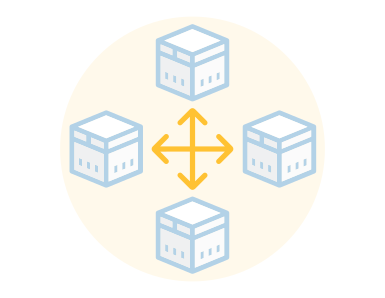
Colony density may be adjusted depending on orchard layout, tree age, bloom intensity and the presence of additional pollinating insects.
Bumblebee Hives for Blueberry Orchards
Explore Zonda Beneficials bumblebee hives for greenhouse and outdoor crop pollination to support blueberry production.
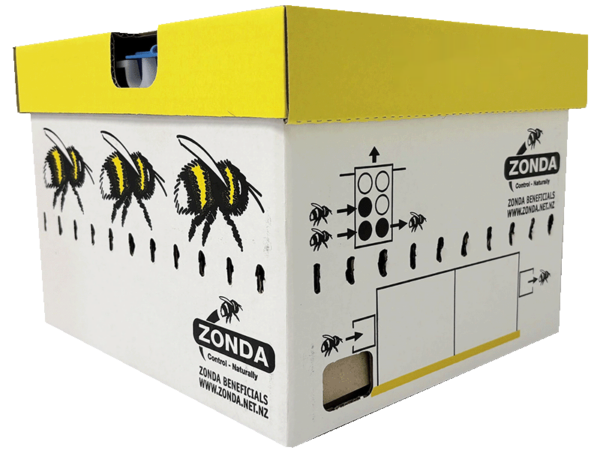
Large Hive
1100 m² to 1500 m²
Contains approximately 80–100 worker bees.
Bumblebee Hive Placement and Use
- Introduce colonies when the first flowers are open.
- Place hives on a sturdy support approximately 50 cm above the ground — sunny in spring, shaded later in the season.
- Secure hives to prevent ant access.
- After placement, allow bees to settle for 30–60 minutes before opening the flight hole. They will begin pollinating shortly after their initial orientation flights.
- Bumblebees are most active between 15–25°C, and will work in temperatures from 10–30°C.
Bumblebee Safety and Crop Protection
- Bumblebees are compatible with natural enemies and biological control programmes.
- Agricultural chemicals can affect bumblebees directly (killing workers or larvae through contact or ingestion) or indirectly (treated flowers may deter foraging visits).
- Systemic pesticides can have long-lasting effects. In crops that produce both nectar and pollen (e.g. sweet pepper), the impact on the colony can be significantly greater than in pollen-only crops (e.g. tomato).
- Detailed information on pesticide compatibility is available in Zonda’s Side Effects Guide.
- Before any crop treatment, activate the BEEHOME option to allow bees to enter but not leave the hive. After approximately one hour, the hive can be fully closed and either covered or removed from the crop.
- If temporarily removed, store the hive at 18–20°C.